
The final Budget for the fiscal is likely to be tabled in July after formation of the new government.

'In the Mahabharat, when faced by an enemy, Yudhishtir, the eldest Pandav, had quipped that 'When it comes to external enemies, we are 105, (100 Kauravs and 5 Pandavs)'.' 'It is time modern politicians heed this ancient wisdom,' says Colonel Anil A Athale (retd).

The April-June quarter GDP slipped to 7 per cent from 7.5 per cent.

Despite the hope that lessons will be learnt, the next accident invariably shows that nothing has been learnt -- or if learnt, they have been ignored, observes Prosenjit Datta.

Only one of the three drivers of the economy has performed in the way it should: government spending grew at 15.6 per cent, reports Abhishek Waghmare.

India's economy grew by 6.3 per cent in the second quarter of the current fiscal, official data released on Wednesday showed.

The CSO said that the first revised estimates for 2016-17 have been compiled using industry-wise/institution-wise detailed information instead of using the benchmark-indicator method employed at the time of release of Provisional Estimates on May 31, 2017.

19 per cent of all travel in India (by bus, train or air) was pilgrimage or religious travel (possibly the single largest after business and family-related travel), discovers Ambi Parameswaran.

The Indian economy appears to have slowed down in 2018-19 due to lower private consumption, tepid growth in fixed investment and muted exports, a finance ministry report has said.

After contracting for two quarters in a row, the Indian economy entered the positive territory with a growth of 0.4 per cent in the October-December quarter, mainly due to good performance by farm, services and construction sectors, official data showed on Friday. Trade and hotel industry registered a contraction of 7.7 per cent during the third quarter this fiscal, as the sectors continued to suffer on account of coronavirus pandemic. According to the data released by the National Statistical Office (NSO), the farm sector recorded a growth of 3.9 per cent, and the manufacturing sector output grew by 1.6 per cent in the quarter under review.

'A growth of above 7 per cent when the fundamentals of the economy are becoming stronger still makes India the fastest growing large economy.'

Rajan, who has also served as chief economist at the International Monetary Fund (IMF), said he had no idea what statistics are pointing at currently and "a revamp" was needed "to really figure out what India's true growth rate is".

Retail inflation softened to 6.71 per cent in July due to moderation in food prices but remained above the Reserve Bank's comfort level of 6 per cent for the seventh consecutive month. With retail inflation continuing to remain high despite a fall in prices of vegetables and edible oils, among other commodities in July, the Reserve Bank of India (RBI) might go for another rate hike in September. The Consumer Price Index (CPI) based retail inflation was at 7.01 per cent in June and 5.59 per cent in July 2021. It was above 7 per cent from April to June this fiscal.
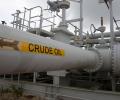
Retail inflation hit an eight-month high of 6.07 per cent in February, remaining above the RBI's comfort level for the second month in a row, while wholesale price-based inflation soared to 13.11 per cent on account of hardening of crude oil and non-food item prices, government data showed on Monday. The previous high for retail inflation was 6.26 per cent in June 2021. The consumer price index (CPI) based retail inflation, which is taken into account by the Reserve Bank of India (RBI) while deciding its monetary policy, rose mainly because of costlier food items, as per the data released by the National Statistical Office (NSO).

Public sector banks have lost nearly Rs 2.85 lakh crore on account of loan dues of 13 corporates even as the banks are used to bail out ailing financial institutions such as Yes Bank and IL&FS, United Forum of Bank Unions alleged on Monday. In a press release, UFBU's convener B Rambabu said the organisation calls for a two-day all India bank strike on December 16 and 17 protesting against Banking Laws (Amendment) Bill 2021 and opposing the Centre's alleged move to privatise PSBs. According to the statistics given by the UFBU, the 13 corporates' outstanding dues were at Rs 486,800 crore and it was resolved at Rs 161,820 crore resulting in a loss of Rs 284,980 crore.

'Already, the temperature has touched 39 degrees in some parts of Gujarat and now we are in the last week of February.' 'We need to activate the heat action plan from March 1.'
Retail inflation eased to 7.04 per cent in May, mainly on account of softening food and fuel prices as the government as well as the RBI stepped in to control spiralling price rise by way of duty cuts and repo rate hike. However, the inflation print stayed above the Reserve Bank's upper tolerance level of 6 per cent for the fifth month in a row. The Consumer Price Index (CPI) based retail inflation was 7.79 per cent in April.

Chief economist at State Bank of India has revised downward the full-year growth forecast to a low 6.8 per cent from 7.5 per cent earlier for FY2023, citing "the way below GDP numbers for the first quarter". The National Statistical Office on Wednesday released the Q1 growth numbers which showed a consensus growth of 13.5 per cent, pulled down by the poor show of the manufacturing sector, which reported a paltry 4.8 per cent expansion in the first three months of FY23, negating the robust show by the services sector. Consensus forecast was 15-16.7 per cent of which the RBI made the highest forecast of 16.7 per cent.

China's covid crisis could provoke a raw material crunch for India's EV industry later this year.

Industrial production re-entered the negative territory by contracting 1.6 per cent in January, mainly on account of the decline in output of capital goods, manufacturing and mining sectors. The output of the manufacturing sector -- which constitutes 77.6 per cent of the Index of Industrial Production (IIP) -- shrank by 2 per cent in January, as against a growth of 1.8 per cent during the same month last fiscal, as per data released by the government on Friday. The worst performance was witnessed by the capital goods sector, which recorded a contraction of 9.6 per cent during the month under review, compared to a 4.4 per cent decline a year ago.

Releasing the survey report after taking into account the expert committee recommendations, Statistics Secretary Pravin Srivastava told reporter, "It is a new design and a new matrix. It would be unfair to compare it with the past. This 45- year high is your interpretation. I don't want to claim that it is 45-year low or high."

The Indian economy can contract by 7.7 per cent in current financial year ending on March 31 and the growth could be 11 per cent in the next financial year, according to the Economic Survey tabled in Parliament by Finance Minister Nirmala Sitharaman. The contraction in FY21 is mainly due to coronavirus (Covid-19) pandemic and the visible damage caused by the subsequent countrywide lockdown to contain it. The survey unveiled two days before the Union Budget is broadly in line with forecasts by the Reserve Bank of India (RBI) which has said it expected the country's GDP to contract by 7.5 per cent in the year ending March 31.

The World Bank has retained India's economic growth forecast for the current fiscal at 8.3 per cent as the recovery is yet to become broad-based. As per the first advanced estimates of the national income released by the National Statistical Office (NSO) last week, the economy is projected to grow at 9.2 per cent in 2021-22, surpassing pre-COVID level in actual terms, mainly on account of improved performance, especially in farm, mining and manufacturing sectors. "India's economy is expected to expand by 8.3 per cent in fiscal year 2021/22 (ending March 2022), unchanged from last June's forecast as the recovery is yet to become broad-based.
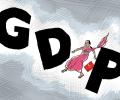
India's gross domestic product (GDP) growth slowed to 4.1 per cent in January-March 2022 period, while for the full year 2021-22 the growth stood at 8.7 per cent, according to the government data released on Tuesday. GDP at constant (2011-12) prices in Q4 2021-22 is estimated at Rs 40.78 lakh crore, as against Rs 39.18 lakh crore in Q4 2020-21, showing a growth of 4.1 per cent, as per the National Statistical Office (NSO) data. India's GDP growth has slowed for the third straight quarter.

Industrial production surged by 13.6 per cent in June mainly due to a low-base effect and good performance by manufacturing, mining and power sectors but the output remained below the pre-pandemic level. The manufacturing sector, which constitutes 77.63 per cent of the Index of Industrial Production (IIP), grew by 13 per cent in June this year, according to the data released by the National Statistical Office (NSO) on Thursday. The mining sector output rose by 23.1 per cent in June while power generation increased by 8.3 per cent.
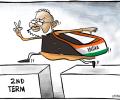
The government's decision to release the reports comes two days after over 200 scholars from across the globe issued a statement demanding release of all withheld reports produced by the NSO, including the household consumer expenditure survey that was junked.

'We are looking at the Budget with the hope that it will address all issues even at the cost of exceeding the fiscal deficit target.'

India's GDP estimates for 2020-21 show that the economy is expected to perform much better than earlier projections by different agencies, indicating a sustained V-shape post-lockdown recovery, experts said. The first Advance Estimates (AE) by the National Statistics Office (NSO) has projected a contraction of 7.7 per cent in the real GDP during 2020-21. This was better than the projections by certain international agencies like the IMF and World Bank.

the GDP estimates incorporate new source data and modified compilation techniques

The increase in death registration in 2020 compared to 2019 is not entirely due to Covid fatalities, Niti Aayog member VK Paul has said, asserting that "exorbitant" multiples of coronavirus deaths being published by some agencies with respect to India must stop.

Leading economists have pencilled in a high 13-15.7 per cent uptick in the economy in the first quarter of 2022-23 with an upward bias. Soumya Kanti Ghosh, the group chief economic adviser at State Bank of India, on Tuesday said he expects the GDP to clip past 15.7 per cent in the first quarter with more chances of the final numbers printing in higher, while Aditi Nayar, the chief economist at the rating agency Icra, said the economy will grow much lower at 13 per cent in the June quarter. The national statistical office will announce the first quarter GDP numbers later next week.

The UK's death toll now makes it just one of a number of countries to have crossed the 20,000 fatalities mark, after France, Spain, Italy and the United States.

India's industrial production growth slowed down for a fourth straight month in December to 0.4 per cent mainly due to a poor performance by the manufacturing sector. The manufacturing sector, which constitutes 77.63 per cent of the Index of Industrial Production (IIP), contracted by 0.1 per cent in December, according to the data released by the National Statistical Office (NSO) on Friday. In December 2021, the mining output rose by 2.6 per cent, and power generation increased by 2.8 per cent.

Last three weeks have been sleepless roller coaster: Tejaswin after CWG inclusion

Retail inflation remained above the RBI's comfort level for the second consecutive month despite slipping slightly to 6.26 per cent in June while the factory output recorded a growth of 29.3 per cent in May, mainly on account of the base effect, the government data showed. The marginal slippage in the Consumer Price Index (CPI)-based inflation was noticed despite little firmness witnessed in the food inflation which inched up to 5.15 per cent in June from 5.01 per cent a month ago. Retail inflation based on Consumer Price Index (CPI) was 6.3 per cent in May 2021 and 6.23 per cent in June 2020.

Subdued prices of food items like vegetables pulled down retail inflation for the third month in a row to 5.3 per cent in August, within the RBI's comfort zone. While the Consumer Price Index (CPI)-based retail inflation declined to 5.3 per cent in August from 6.69 per cent in the same month a year ago, food inflation dipped at a much faster pace to 3.11 per cent from 9.05 per cent in August 2020. The food inflation was also lower than 3.96 per cent in preceding month of July.
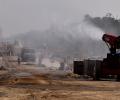
The Supreme Court Wednesday asked the Centre and the NCR states to continue implementing for few days the measures to ensure improvement in air quality, saying that preventive actions are needed in anticipation to curb pollution even as it wondered what signals are being sent to the world.

India's GDP is estimated to contract by a record 7.7 per cent during 2020-21 as the COVID-19 pandemic severely hit the key manufacturing and services segments, as per government projections released on Thursday. Amid overall decline in economic activities, some respite was provided by the agriculture sector and utility services like power and gas supply, which have been projected to post positive growth during the current fiscal ending March 2021.
The country's gross domestic product (GDP) is likely to grow at 5.8 per cent in the third quarter of fiscal 2022, according to an SBI's research report- Ecowrap. The country's economy expanded by 8.4 per cent in the second quarter of 2021-22, to cross pre-pandemic levels. However, the GDP growth in July-September period was slower than the 20.1 per cent expansion in the previous quarter.

The GDP always has a base year, which defines the composition of the economy in that year. As the composition changes, the base year needs to be revised regularly. Abhishek Waghmare explains how that is done.
